 Brindlefield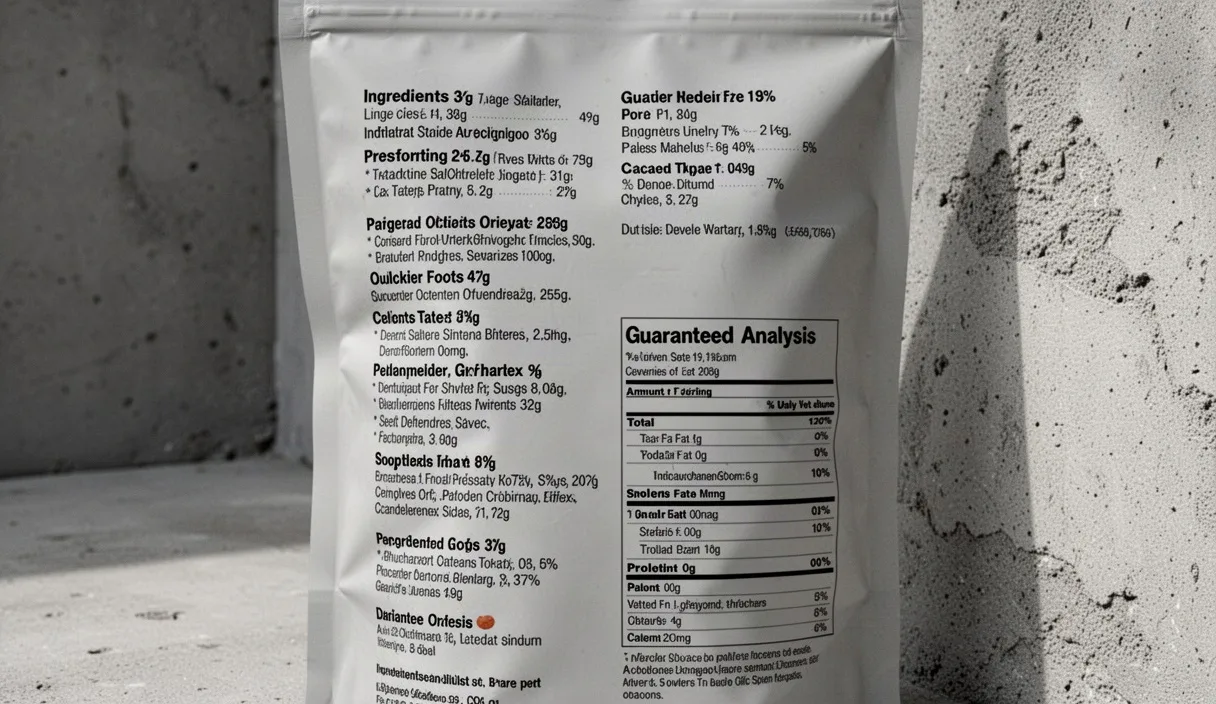
A pet food label is a legal document before it is a marketing tool. Every word on it answers to a regulatory framework, usually the model set out by AAFCO in the United States and adopted, with local edits, by most state feed control officials. Once you know where the rules end and the marketing language begins, the bag or can tells you a lot more than a shelf tag ever will.
This guide walks through the same label section by section: the ingredient list, the guaranteed analysis panel, life stage claims, the loose words that sound official but carry no legal weight, and the fine print that tells you who actually made the food. At the end, a side-by-side comparison shows how to use all of this at once when two bags are sitting on the same shelf.
How Ingredient Order Is Determined
Ingredients on a pet food label are listed by weight, heaviest first, at the point they go into the mixing vat. That single rule explains most of the confusion pet owners run into.
Fresh meat is heavy because it is mostly water, roughly 60 to 70 percent moisture. So "chicken" can legally sit at the top of the list even if, once the water cooks off, it contributes less dry material than a grain listed further down. A dry food that lists "chicken, chicken meal, rice" is not necessarily meatier than one listing "chicken meal, rice, chicken fat." Chicken meal is already rendered and dehydrated, so its listed weight is closer to its actual contribution to the finished kibble.
Manufacturers can also split a single ingredient category into several named parts, a practice sometimes called ingredient splitting. "Pea protein, pea fiber, pea starch" may each rank below the meat sources individually, while the whole pea component, if it were declared as one line, could outweigh the meat. This is legal. It is worth doing basic math on, especially for grain-free formulas that rely heavily on legumes.
- Named meat (e.g., "beef"): must come from that specific animal, includes natural moisture.
- Meat meal (e.g., "beef meal"): rendered and dried, denser in protein by weight, already had water and fat removed.
- Generic terms (e.g., "meat meal," "animal fat"): allowed under AAFCO rules but do not specify species; ask the manufacturer if the species matters to you.
Reading the Guaranteed Analysis Panel
The guaranteed analysis, usually a small box near the ingredient list, states minimum percentages for crude protein and crude fat, and maximum percentages for crude fiber and moisture. "Crude" here is a lab method, not a comment on quality; it measures total nitrogen-based compounds for protein, for example, not how digestible that protein is.
These numbers are given on an "as fed" basis, meaning they include whatever moisture is in the product. This makes comparing a canned food to a dry food directly misleading. Canned food often runs 75 to 82 percent moisture; dry kibble usually sits between 8 and 12 percent moisture. A canned food guaranteeing 8 percent protein "as fed" can easily have more protein than a dry food guaranteeing 24 percent, once water is factored out.
To compare fairly, convert to a dry matter basis. Subtract the moisture percentage from 100 to get the dry matter percentage, then divide the nutrient percentage by that number and multiply by 100.
| Step | Canned food example | Dry food example |
|---|---|---|
| Label protein (as fed) | 8% | 24% |
| Label moisture | 78% | 10% |
| Dry matter (100 - moisture) | 22% | 90% |
| Protein on dry matter basis | 8 ÷ 22 × 100 = 36.4% | 24 ÷ 90 × 100 = 26.7% |
In this example the canned food actually has more protein per unit of dry matter than the dry food, despite the lower number printed on the front-facing part of the label. This calculation takes under a minute with a calculator and is the single most useful skill for comparing wet and dry formulas.
Life Stage Claims and What They Require
Phrases like "for growth," "for maintenance," "for all life stages," or "complete and balanced for adult dogs" are not casual descriptions. Under AAFCO rules, a manufacturer can only make these claims if the food meets one of two conditions: it passed a feeding trial following AAFCO protocol, or its nutrient levels were calculated and confirmed to meet the AAFCO Nutrient Profile for that life stage.
Look for a sentence near the guaranteed analysis or on the back panel that reads something like "[Product name] is formulated to meet the nutritional levels established by the AAFCO [Life Stage] Nutrient Profiles" or "Animal feeding tests using AAFCO procedures substantiate that [product] provides complete and balanced nutrition." These two sentences mean different things. The first is a lab calculation against a published nutrient table. The second means real animals were fed the product and monitored for a set period, generally a minimum of six months for adult maintenance trials.
"All life stages" foods must meet the nutrient profile for growth and reproduction, which is the more demanding of the two profiles. A food labeled this way is not automatically wrong for a senior dog, but its calorie and mineral levels are usually higher than a food built only for adult maintenance. Owners of dogs with kidney concerns or a tendency to gain weight should discuss an "all life stages" product with a veterinarian before switching, since the phosphorus and calorie density can matter for those specific conditions.
Foods labeled only "intended for supplemental or intermittent feeding" have not met a complete nutrient profile and are not meant to be the sole diet. This phrase often appears on toppers, treats, and some canned foods marketed as "stews" or "mixers."
Words That Sound Regulated but Are Not
Several words that carry strong connotations on a pet food bag have no legal definition under AAFCO or MHRA and the FSA rules. Recognizing them keeps a shopping decision grounded in the parts of the label that are actually verified.
- "Premium," "super premium," "ultra": no defined nutrient or ingredient standard; a marketing tier name only.
- "Human-grade": has a narrow legal meaning in some states requiring every ingredient and the facility to meet human food standards, but is used loosely elsewhere; ask the manufacturer if the whole product or just one ingredient qualifies.
- "Natural": AAFCO does define this one, but loosely, it mainly restricts synthetic additives and preservatives; it does not restrict how the ingredients were sourced or processed otherwise.
- "Holistic": no regulatory definition at all.
- "Grain-free": accurate as a factual claim about grain content, but not a claim about overall nutrient quality; grain-free foods often substitute potatoes or legumes for the starch grains would have provided.
- "Gourmet": no legal meaning.
None of these words are false advertising by themselves. The issue is that they are not checkable against a standard the way "chicken meal" or "crude protein minimum" are. Treat them as flavor text and look past them to the ingredient list, the guaranteed analysis, and the nutrient adequacy statement.
Where to Find the Manufacturer's Contact Information
Every pet food label is required to list the name and address of the manufacturer or distributor. Look for it near the bottom of the back or side panel, often in small print below the feeding guidelines. Since 2007-era rule tightening following the melamine contamination recalls, most companies also print a customer service phone number and, increasingly, a lot code or batch number stamped directly on the package, often near the seal or bottom seam.
The lot code matters more than most shoppers realize. If a recall happens, it is usually tied to specific lot numbers and date ranges, not the entire product line. Photographing the bag's lot code before opening it, or simply saving the bag until the food is finished, makes it possible to check that code against a recall notice later without guessing.
A phone call to the number on the bag is also the fastest way to get a straight answer on questions the label cannot answer: which specific animal a generic "meat meal" comes from, whether a plant is company-owned or a co-packer, or what quality control testing is done per batch. Companies vary widely in how much they will disclose; a company that answers specific sourcing questions promptly is telling you something useful about how the rest of their operation is likely run.
Comparing Two Labels Side by Side
Comparing two dry foods, or two wet foods of the same moisture range, is straightforward: look at ingredient order for the first three to five items, compare guaranteed analysis numbers directly since moisture content is similar, and check that both carry the same life stage statement for the pet in question.
Comparing across categories, wet versus dry, or a fresh-frozen food versus kibble, requires the dry matter conversion described earlier for every nutrient you care about, not just protein. Fat and fiber can be converted the same way: divide the as-fed percentage by the dry matter percentage and multiply by 100.
| Comparison point | Food A (dry) | Food B (wet) |
|---|---|---|
| First ingredient | Chicken | Chicken broth |
| Second ingredient | Chicken meal | Chicken |
| Protein, as fed | 26% | 9% |
| Moisture | 10% | 80% |
| Protein, dry matter basis | 28.9% | 45.0% |
| Life stage statement | Adult maintenance, nutrient profile | Adult maintenance, feeding trial |
In this hypothetical pair, Food B looks less impressive on the front panel but carries more protein once moisture is accounted for, and its adequacy claim rests on an actual feeding trial rather than a calculated nutrient profile. Neither fact alone decides which food is better for a particular animal; a feeding trial confirms the food supported healthy animals under test conditions, while a nutrient profile calculation is a reliable but different kind of assurance. A veterinarian or veterinary nutritionist can help weigh these differences against a specific pet's age, weight, and any diagnosed condition.
Common Mistakes
- Comparing protein or fat percentages between wet and dry food without converting to dry matter basis first.
- Assuming a named meat as the first ingredient means the food is mostly meat by dry weight.
- Treating "natural," "premium," or "holistic" as verified quality markers rather than marketing language.
- Skipping the nutrient adequacy statement and assuming any bag on the shelf is complete and balanced for every life stage.
- Throwing away the bag or can before checking the lot code against an active recall list.
Next Steps
Pull the current bag or can from the pantry and find three things on it right now: the nutrient adequacy statement, the guaranteed analysis panel, and the lot code. Confirm the life stage statement matches the pet actually eating the food. If switching between a wet and a dry product, run the dry matter calculation for protein and fat before assuming one is richer than the other based on the printed numbers alone.
If a pet has a diagnosed medical condition, such as kidney disease, pancreatitis, or a food sensitivity, bring the label, not just the brand name, to the next veterinary visit. The guaranteed analysis and ingredient list give a veterinarian or veterinary nutritionist the specific numbers needed to judge whether a food fits a medical diet plan, which a brand name alone cannot do.