 Brindlefield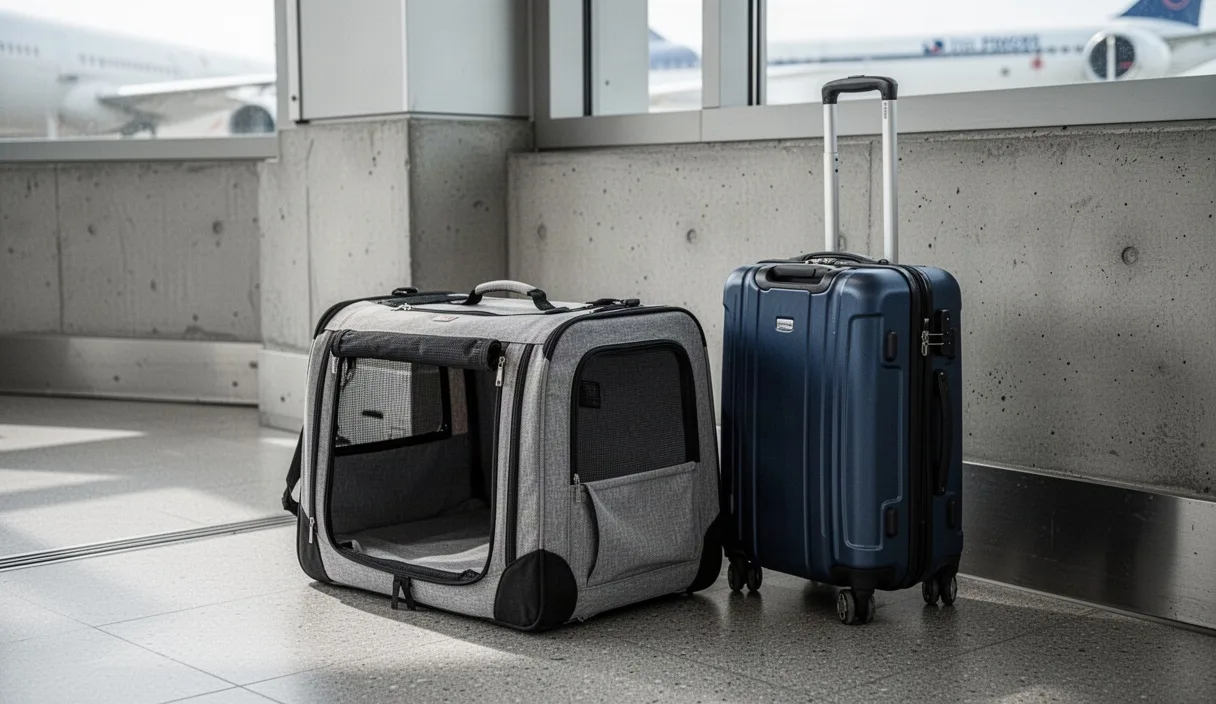
A carrier is the one piece of gear that decides whether flying with a cat is manageable or miserable. It has to fit under an airline seat, hold up for hours without collapsing, and give a stressed animal enough air and enough darkness to settle down. Get the wrong one and you find out at the gate, when an agent measures it and tells you it does not fit.
This guide walks through the actual decisions: which rules to check first, whether soft-sided or hard-sided makes sense for your airline and your cat, what ventilation and visibility features do, how to condition a cat to the carrier before travel day, how to pack it for a multi-hour flight, and what happens at security and boarding. None of this replaces advice from your vet, especially for cats with health conditions or extreme anxiety around confinement.
Airline Size Rules and Where to Find Them
Every airline publishes maximum carrier dimensions for in-cabin pets, but the numbers are not standardized. A carrier that fits under the seat on one airline can be too tall for another. Typical cabin carrier limits run around 18 inches long by 11 inches wide by 11 inches high, but some carriers allow slightly more length if the height is lower, and some airlines measure the carrier with the cat inside, not empty.
Find these rules on the airline's own pet travel page, not on a third-party blog. Airline policies change, and a carrier that was compliant last year may not be this year. Call the airline's reservations line and ask them to confirm the exact dimensions and whether they measure hard-sided cases differently from soft-sided ones, since soft bags compress and some gate agents allow a little give.
Book the pet spot as early as possible. Most airlines cap the number of in-cabin pets per flight, often between two and six, and that slot is separate from your own seat reservation. If the flight is full of pets already, you will be told to rebook, and that is not something you want to discover the morning of departure.
Write down the airline's specific requirements before you shop for a carrier. Useful things to note:
- Maximum external dimensions in inches or centimeters
- Whether the carrier must fit fully under the seat with no part protruding
- Any weight limit for the cat plus carrier combined
- Whether a health certificate or vaccination record is required at check-in
- Fees for an in-cabin pet, which commonly range from 100 to 200 dollars each way
Soft-Sided vs Hard-Sided Carriers for Cabin Travel
Soft-sided carriers are made from nylon or similar fabric over a wire or plastic frame. They compress slightly, which helps them squeeze under a low seat, and they weigh less, which matters when you are also carrying a bag. Most airlines accept them for cabin travel without objection because they are the default choice for pet owners.
Hard-sided carriers are rigid plastic shells, similar to a small version of cargo crates. They protect a cat from being crushed if bags get stacked on top of the carrier in an overhead bin, but overhead bin storage is rarely allowed for live animals in the cabin, so this advantage matters less for air travel than for car trips. Hard-sided cases also do not compress, so if your carrier is at the airline's exact size limit, a hard case is more likely to get rejected at the gate.
For a cat that pushes against the sides when frightened, a soft-sided carrier with a rigid base can be a middle ground. The base keeps the shape stable enough for the cat to stand and turn around, while the sides stay flexible enough to fit into tight under-seat spaces.
| Feature | Soft-sided | Hard-sided |
|---|---|---|
| Typical weight | 1 to 3 lbs | 3 to 6 lbs |
| Fits under airline seat | Usually, compresses slightly | Sometimes, no give |
| Cleaning | Wipe or hand wash liner | Wipe down, dishwasher-safe in some models |
| Cat's ability to press against walls | Flexes under pressure | Stays rigid |
Ventilation and Visibility Features That Matter
Mesh panels on at least three sides let air move through the carrier even when it is packed under a seat where airflow is already limited. A carrier with mesh only on the front door will feel stuffy after two or three hours, especially on a warm aircraft before the air conditioning kicks in on the ground.
Some cats calm down faster when they cannot see the cabin at all. Others panic in total darkness. Look for a carrier with a mesh panel that has a fabric flap you can roll down and secure with velcro or a zipper. This lets you test both options on the ground before the flight and choose based on how your cat actually reacts, rather than guessing.
Top-loading access, a zippered opening on the top of the carrier in addition to the front, makes it much easier to reach in and check on a cat or offer a treat without fully opening the carrier at your feet in a crowded gate area. This matters more than it sounds like it would when you are trying to keep a frightened animal from bolting into a terminal.
A carrier with a clear or mesh window near eye level, not just at the front door, also helps a flight attendant do a visual check if one is required, without you having to unzip anything mid-flight.
How to Get a Cat Used to the Carrier Before the Trip
Do not introduce the carrier for the first time on travel day. Set it up in a room the cat already uses, with the door open, at least two to three weeks before departure. Put a familiar blanket or an unwashed item of your clothing inside so it smells like home rather than like a plastic store box.
Feed treats near the carrier for the first few days, then feed them just inside the doorway, then feed a full meal inside the carrier with the door open. Most cats will start walking in on their own within a week if there is no pressure attached to it. Skip this step and you are trying to force a cat into a box for the first time right before a flight, which almost always ends badly for everyone nearby.
Once the cat is comfortable eating inside, start closing the door for short periods, a minute or two at first, while you stay in the room. Extend this gradually to 20 or 30 minutes over the following days. Then practice carrying the closed carrier around the house and up and down stairs, since a cat that is fine sitting still in a carrier can still be startled by the motion of being carried.
If your cat still shows signs of significant distress, heavy panting, prolonged yowling, attempts to claw through mesh, after two weeks of this kind of gradual exposure, talk to your vet before the flight. Some cats are not good candidates for cabin air travel regardless of preparation, and a vet can discuss options, including whether sedation is appropriate, which is a decision that should only be made with veterinary guidance.
Packing the Carrier for a Multi-Hour Flight
Line the base with an absorbent pad designed for pet accidents, not just a towel. A towel soaks through and leaves a cat sitting in dampness for the rest of the flight. Pads with a waterproof backing keep the mess contained to the pad itself.
Skip food and water bowls inside the carrier during the flight itself. Bowls spill the moment the carrier is lifted or set down, and a wet carrier is worse than a hungry cat for a flight that typically lasts under six hours. Offer water and a small meal a few hours before departure instead, and pack a collapsible bowl in your carry-on for use after landing.
Bring one familiar-smelling item, a small piece of blanket or a worn t-shirt, but avoid overpacking the interior. A cat needs enough room to stand up, turn around, and lie down without extra padding shrinking that space. Extra toys or excess bedding just give the cat something to get tangled in or push out of the mesh panels.
A few items worth having in your carry-on bag, not inside the carrier:
- Puppy pads or pet wipes for a quick cleanup if there is an accident
- A collapsible fabric bowl for water after landing
- A printed copy of vaccination records and any required health certificate
- A photo of your cat on your phone, in case the carrier needs to be opened and the cat gets loose
What to Do at Security and Boarding
At the security checkpoint, you will be asked to remove the cat from the carrier and carry it through the metal detector while the empty carrier goes through the X-ray belt. Keep the cat on a secure harness under your clothing or held firmly against your chest, since this is one of the highest-risk moments for a cat to slip loose in a crowded space. Some airports have a separate pet screening lane, ask an officer if you do not see one.
Get to the gate early and ask the agent to confirm your pet reservation is showing on their system before boarding begins. This avoids a scramble at the last minute if there is any mismatch between what you booked and what the airline's system shows.
Board during your assigned group like any other passenger, and once seated, slide the carrier fully under the seat in front of you. Airlines require the carrier to stay there for the entire flight, not on your lap and not on the seat next to you, even if that seat is empty. Flight attendants do check on this during taxi and after takeoff.
Do not open the carrier at any point during the flight, even to comfort the cat, unless a flight attendant specifically permits it. An open carrier in a moving aircraft cabin is how cats end up loose under multiple rows of seats, which delays the flight for everyone and puts the animal at real risk.
Common Mistakes
Buying the carrier the week of the flight and never testing it at home is the single most common error. The cat associates the carrier only with the stress of the trip itself, with no positive experience to draw on.
Assuming all airlines use the same size limits. A carrier that fit on one airline last year can be rejected by a different airline or a different aircraft type on the same airline.
Packing food and water bowls inside the carrier for the flight, which almost guarantees a spill and a wet, unhappy cat for the remainder of the trip.
Sedating a cat without veterinary guidance. Some sedatives affect breathing and blood pressure in ways that are riskier at cabin altitude, and this decision should go through a vet, not a guess based on what worked for a friend's dog.
Next Steps
Call your airline directly and get carrier size limits and pet fees in writing or by email before you buy anything. Then choose a soft-sided carrier with mesh on at least three sides and a top-loading zipper, and start the two to three week conditioning process well before your booked date. Pack an absorbent pad instead of bowls for the flight itself, and keep water and food access to before departure and after landing. If your cat shows strong distress signs during home practice, schedule a call with your vet to talk through options before you finalize the trip.